
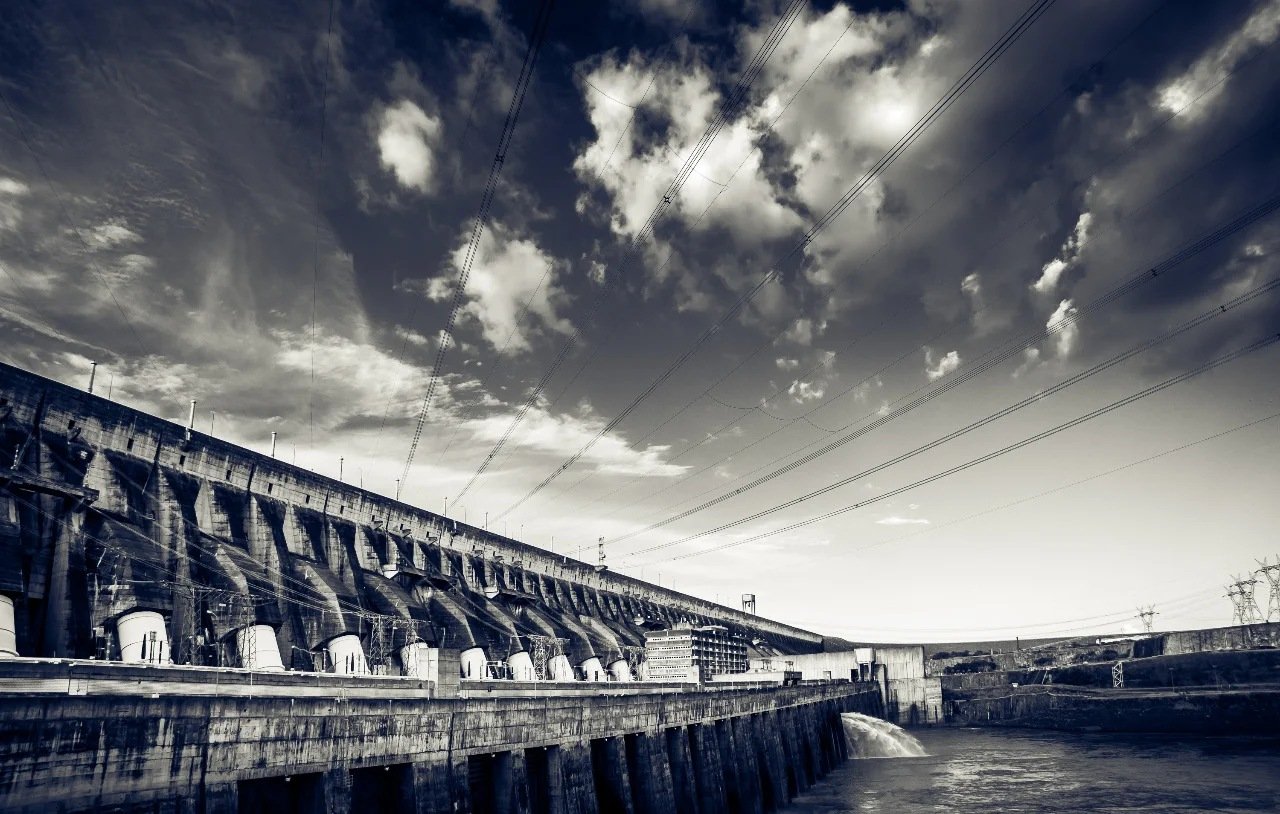
Justice at Itaipu
The story behind the numbers
Itaipu has generated more electricity than any other hydropower plant in history. According to Guinness World Records, it is also the most expensive single object on Earth.
A binational dam, owned in equal parts by Paraguay and Brazil, Itaipu is one of Paraguay’s greatest assets: its main source of electricity and a major foreign-exchange earner for the national treasury.
For the past decade, DEMOS has studied its accounts. More than half a century after the signing of the 1973 Treaty, we seek to answer questions that remain unanswered: how much the dam really cost, why it cost so much, who bore that cost, and how much Paraguay would have received if the energy it ceded to Brazil had been sold at market prices.
Through this research, DEMOS seeks to improve public debate on Itaipu. We contribute new data developed through rigorous research and a measured assessment of an issue at the heart of the relationship between Paraguay and Brazil.
We undertake this work without hostility, guided by a firm commitment to transparency, justice, and mutual respect for each nation’s sovereignty. These principles are the foundation of a stronger relationship and closer ties between the people of these two neighboring countries.
How much Itaipu really cost
The binational entity reports several figures for the dam’s cost. They measure different concepts and yield different totals. Using its own balance sheets, we reconstructed the amounts actually paid, year by year.
Why it cost so much
In addition to construction costs, the study examines the cost of borrowing: the debt, interest rates, and financial terms that made financing more expensive over half a century.
Decisions, not just context
The oil shocks, the debt crisis, and Brazilian inflation shaped this period. But the study highlights the impact of specific decisions—made or not made by identifiable institutions at particular moments.
Who paid
We trace how the cost of the debt was passed on through Itaipu’s electricity tariff to the bills paid by households and businesses on both sides of the Paraná River.
Paraguay’s ceded energy
Paraguay cedes most of its share of Itaipu’s electricity to Brazil. The study compares what it received in return with the value of that energy in the Brazilian market.
What Itaipu does not publish
Itaipu does not publish all the information needed for an audit. Several data series had to be reconstructed from official sources. This lack of information is itself a finding.
Why the study matters now
Paraguay and Brazil are reviewing Annex C of the Treaty, which establishes Itaipu’s financial framework. The study provides evidence to inform that discussion.
How we work
We describe this work as a financial archaeology of Itaipu. Using scattered and incomplete records, we have reconstructed half a century of accounts and analyze them in light of the historical context and the power relations at play.
The study draws on official sources: Itaipu’s balance sheets, annual reports, and contracts, and statistics from public institutions in Brazil and Paraguay. Using these sources, we have built dozens of databases. Every reconstructed series is identified as such, and all monetary values are expressed in constant 2024 U.S. dollars. It is an honest reading of the numbers: we report what the data show.
To assess the impact of excess construction costs and financing costs, we use counterfactual scenarios: what would have happened to the debt, the electricity tariff, and electricity bills if certain decisions had not been made. These methods are used in forensic accounting.
The study is now undergoing final verification and peer review.
We presented preliminary findings in Asunción in 2018 and 2019, in Ciudad del Este and to electricity-sector unions in 2019, and before Paraguay’s National Congress in 2022 and 2023. In August 2026, President Santiago Peña received an update on the study at Mburuvichá Roga, the presidential residence. Members of his cabinet also attended, as did the president of ANDE, Paraguay’s state electricity company and co-owner of Itaipu.
Justice at Itaipu: the book

The findings will be published in Justice at Itaipu (Justicia en Itaipú), a book edited by Miguel Carter. It brings together more than thirty contributors from Paraguay, Brazil, and other countries, with backgrounds in history, political science, economics, energy, law, and diplomacy, along with voices of the Ava Guaraní people. The preface is by Alfredo Boccia and the afterword by Milda Rivarola. Contributors write in their individual capacities.
Contents
The book is in Spanish. The chapter titles below are English translations.
Introduction
Itaipu: A National Asset and ChallengeMiguel Carter, DEMOS
Financial Archaeology of Itaipu
The Extraordinary Cost of Itaipu and Its Heavy Debt BurdenMiguel Carter, DEMOS; César Cardozo, former finance manager, Itaipu Binacional
Itaipu: The Unwarranted TariffMiguel Carter, DEMOS
How Paraguay Was Deprived of Its Energy WealthMiguel Carter, DEMOS
History and Its Legacies
A Brief History of Brazilian Expansionism in ParaguayVíctor-Jacinto Flecha, Center for Research and Training in Public Administration
Paraguay and Brazil: Two Centuries of RelationsEduardo Nakayama, Paraguayan Academy of History
The Border Crisis at the Guairá Falls and the Origins of ItaipuJacob Blanc, University of Edinburgh
Itaipu and Brazil’s Large Construction Firms: A History of Power and CorruptionPedro Henrique Pedreira Campos, Federal Rural University of Rio de Janeiro
The Disappearance of the Guairá FallsAndrés Colmán Gutiérrez, El Otro País
A Turbulent Arrival: Itaipu’s Impact on Paraguayan SocietyGustavo Laterza Rivarola, Catholic University “Nuestra Señora de la Asunción”
The Deadly Sins: An Account of Misappropriation at ItaipuJuan Antonio Pozzo Moreno, brigadier general (retired)
Itaipu at a Crossroads
Paraguay and Itaipu: A Matter of AttitudePedro Ferreira, former president, ANDE
Itaipu from the Inside: Paraguayan Acquiescence to Brazilian InterestsLuis M. Fleitas, former superintendent of Renewable Energy, Itaipu Binacional
Itaipu and Competing Visions for ParaguayRamón Casco Contreras, ABC Color
Authoritarian Legacies and the Controversy over ItaipuPaola Cesarini, DEMOS
Itaipu’s Political Power Lies in Popular SovereigntyEstela Ruiz Díaz, Última Hora
Revising the Itaipu Treaty: Context, Vulnerabilities, and Paraguay’s OptionsAndrew Nickson, University of Birmingham
Debating the Development Model
Itaipu and the Uprooting of the Guaraní NationBartomeu Melià, Padre Antonio Guasch Center for Paraguayan Studies (CEPAG)
Itaipu’s Historical Debt to the Ava Guaraní People of the ParanáAsociación Yvy Paraná Rembe’ype
Itaipu: A Paradigm of Economic Development and Inconsistent Energy and Environmental Policies in ParaguayLorraine Ocampos, economist
Hydropolitics at Itaipu: The Potential for Development and GrowthChristine Folch, Duke University
Itaipu: Sovereignty, State, Infrastructure, and Sustainable DevelopmentRicardo Canese, former Mercosur parliamentarian
Itaipu Binacional: Risks and Opportunities for Local Content DevelopmentWalter Zárate, economist
Regional and Energy Integration: Options for ParaguayRamiro Bertoni, Torcuato Di Tella University / DEMOS
Diplomatic, Political, and Legal Strategies
The Geopolitics of Itaipu: Paraguay and the Weapons of the WeakLuis Fretes Carreras, Jesuit University of Paraguay; Andrés Malamud, University of Lisbon
A Small State in an Asymmetric Relationship: Lessons from the Panama CanalTom Long, University of Warwick
Itaipu and Brazilian DiplomacyDawisson Belém Lopes, Federal University of Minas Gerais
Paraguay through the Eyes of Brazilian ElitesSean Burges, Carleton University / DEMOS
No Country Is Too Small to MatterEsteban Caballero, FLACSO Paraguay
Paraguay’s Setback at Yacyretá: Lessons for Revising the Itaipu AgreementsMiguel Carter, DEMOS; Axel Benítez, adviser to the Congressional Commission on Binational Entities
International Law, the Use of Rivers for Development, and the Itaipu TreatyMaría A. Gwynn, University of Bonn
Failed Negotiations: How Can We Resolve a Potential Legal Dispute over the Itaipu Treaty?Verónica Franco, Ferrere Abogados
It Is Time to Review Itaipu’s AccountsGladys Benegas, former finance director, Itaipu Binacional
Conclusion
Justice at Itaipu: A Binational CauseMiguel Carter, DEMOS
DEMOS in the press
DEMOS’s research on Itaipu has been cited in the international press.
- The Guardian“Should Paraguay invest its energy wealth in bitcoin mining or fighting poverty?”November 5, 2018
- Financial Times“Itaipu dam talks set to release pent-up energy”June 11, 2019
- Americas Quarterly“Why Has Energy Spawned a Political Crisis in Paraguay?”August 14, 2019
- The Economist“A dam mess”August 24, 2019
- Foreign Policy“The Dam That Sparked a South American Spying Scandal”July 10, 2025
Also in Brazil and Paraguay: Brasil de Fato, ABC Color, Última Hora, and Ñanduti.
The figures cited in these articles come from preliminary studies (2018–2019). The final results will be published in the book.
Archive
Itaipú, causa nacional: la riqueza energética perdida del Paraguay (Itaipu, a National Cause: Paraguay’s Lost Energy Wealth). DEMOS presentation, Asunción, April 8, 2019 (PDF, in Spanish).
These preliminary results were obtained using a methodology that was subsequently thoroughly revised for the current study. They are preserved as a record of the research.
Banner photo: Alexandre Marchetti.